Back Where You Came From

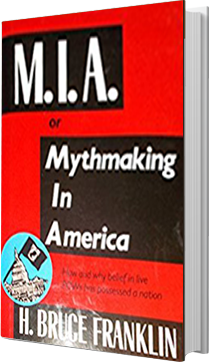
This paperback edition of M.I.A. or Mythmaking in America adds major new material about Ross Perot’s role, the 1991-1992 Senate investigation, and illegal operations authorized by Ronald Reagan.
“A calm and thoughtful book on a firestorm of a subject. Intelligent, provocative, courageous.” —Kirkus Reviews”
An important and compelling book. Franklin raises and answers all of the hardest questions about an enduring piece of political mythology.” —The Philadelphia Inquirer”
Mr. Franklin’s meticulously researched book . . . casts strong light on the Indochina war’s ghostly and ghastly afterlife.” –Todd Gitlin, The New York Times Book Review”
Finally, someone has put the Vietnam legacy of alleged MIA survival in a wider political and cultural setting. A gripping account of subversion from above, a book that should be read by all Americans.” –Richard Falk, Milbank Professor of International Law, Princeton University”
A major critical study on one of the central public myths of our time.” –Richard Slotkin, Olin Professor of English and American Studies, Wesleyan University”
A book that desperately needed to be written.” —The Asian Wall Street Journal”
Franklin’s scholarship is meticulous, and he has been careful to keep most of the documentation in the endnotes. He wants this book to be read not simply by scholars, many of whom already agree with his conclusions, but by those nonacademic readers most in need of some release from the terrible thralldom of the POW/MIA myth.” –John Carlos Rowe, The Journal of American History”
Written by one of America’s most distinguished literary and cultural historians, M.I.A. OR MYTHMAKING IN AMERICA is in the radical tradition of I. F. Stone and Noam Chomsky. Deliberately written in an open and accessible style designed to reach a wide audience, the book is a crucial work in this field. Meticulously nuanced and scrupulously documented.” –Tony Williams, Viet Nam Generation
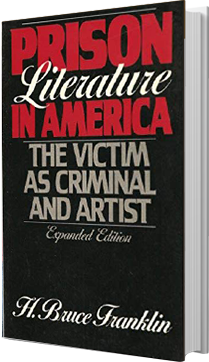
Prison Literature in America–the first full-length study of American prison literature–has become a landmark work in American cultural history, Marxist theory, and the relations between crime and art. This greatly expanded third edition contains much new material, especially on current prison literature, and the Annotated Bibliography of Published Works by American Prisoners and Ex-Prisoners has doubled since the 1978 edition
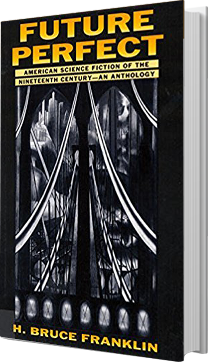
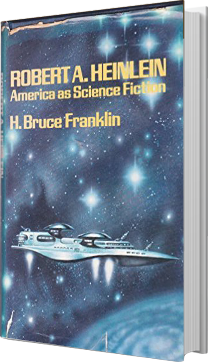
This selection of unusual storeis by important American writers-Hawthorne, Melville, Poe, Bellamy and Twain-and by less well-known tellers such as Ambrose Bierce, S. Weir Mitchell and Fitz-James O’Brien, challenges the commonly held belief that science fiction is a twenthiethcentury phenomenon, or that it began with Jule Verne and H,. G. Wells. Here are tales of marvelous inventions, automanta, biolgocial and psychological experiments, utopias, extra-sensory perception and time and space travel. Many of them have been out of print since before World War I, but they remain high in intrinsic interest of the general reader and for the specialist.
The accompanying critical essays explore the relationships between science fiction and other financial modes, and illuminate the nataure of the bonds betwen science and society and fantasies and social aspirations. Professor Franklin also offers an original, theoretical definition of science ficiton. This book comes as a revelatin. One of the best-edited anthologies I have ever encountered…Mr. Franklin’s critical introductions, containing much valuable information about many works not included in this book, are as interesting as the stories he prints.
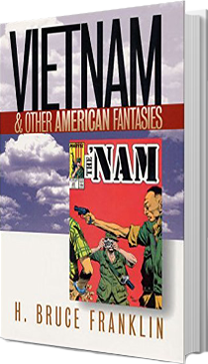
There is now fairly widespread acknowledgment that the Vietnam War shattered many of the traditional narratives central to formerly prevailing vision of the United States and its history. Some people regret this and seek to restore old narratives that they consider essential to a unifying national identity, but their mighty efforts are unlikely to put Humpty Dumpty together again. Others see this shattering as a liberation from dangerous illusions, a wake-up call that forced millions of Americans toward more truthful and beneficial narratives about American history and culture. There is a third view, one that has gained considerable influence in intellectual circles, that sees any “master narrative” or “meta-narrative”―or, for that matter, any coherently structured narrative―as a socially constructed fantasy that radically falsifies the fragmentary, conflicted, and de-centered character of social experience. Although in this book the author does not engage in overt arguments about narrative theory, he does operate from a theoretical position that highly values narratives, especially coherently structures narratives―including some forms of fantasy―as crucial to comprehending, within our human limits, human reality.
“A brilliant reinterpretation of the Vietnam War, showing how it continues to infect the political imagination of America. Of particular value is Franklin’s unique capacity to link the fantasies of science fiction with the construction of grotesque political myths. At a time when the mainstream is struggling to put a silver lining around the collective memory of the Vietnam War, this book is indispensable.” –Richard Falk, Albert G. Milbank Professor of International Law and Practice, Princeton University
- “Wonderfully written, deeply researched, and insightfully argued.”
- –Christian Appy, author of Working Class War: American Combat Soldiers in Vietnam
- “What marks this provocative and engaging book is H. Bruce Franklin’s steadfast resistance to a society that takes ‘plausible deniability’ as its first principle. The range of subjects considered, Franklin’s clear-headed analysis, and his impressive knowledge all make this an important contribution.“
- –Marilyn Young, author of The Vietnam Wars, 1945-1990
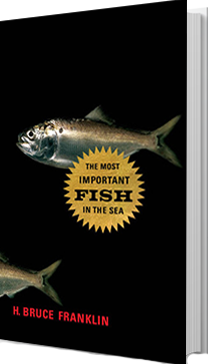
In this brilliant portrait of the oceans’ unlikely hero, H. Bruce Franklin shows how menhaden have shaped America’s national—and natural—history, and why reckless overfishing now threatens their place in both. Since Native Americans began using menhaden as fertilizer, this amazing fish has greased the wheels of U.S. agriculture and industry. By the mid-1870s, menhaden had replaced whales as a principal source of industrial lubricant, with hundreds of ships and dozens of factories along the eastern seaboard working feverishly to produce fish oil. Since the Civil War, menhaden have provided the largest catch of any American fishery. Today, one company—Omega Protein—has a monopoly on the menhaden “reduction industry.” Every year it sweeps billions of fish from the sea, grinds them up, and turns them into animal feed, fertilizer, and oil used in everything from linoleum to health-food supplements.
The massive harvest wouldn’t be such a problem if menhaden were only good for making lipstick and soap. But they are crucial to the diet of bigger fish and they filter the waters of the Atlantic and Gulf coasts, playing an essential dual role in marine ecology perhaps unmatched anywhere on the planet. As their numbers have plummeted, fish and birds dependent on them have been decimatedand toxic algae have begun to choke our bays and seas. In Franklin’s vibrant prose, the decline of a once ubiquitous fish becomes an adventure story, an exploration of the U.S. political economy, a groundbreaking history of America’s emerging ecological consciousness, and an inspiring vision of a growing alliance between environmentalists and recreational anglers.
“How is it possible that a sizeable fish vital to the oceanic food chain and intertwined for three centuries with the cultural histories of both natives and settlers could nevertheless completely escape the notice of most Americans and within a few short years be driven to the brink of extinction for no valid reason whatever? This well researched and vigorously written book–certain to be of wide interest to academic and general readers alike–will tell you why.”
–Lawrence Buell, Harvard University, author of The Environmental Imagination and Writing for an Endangered World
“This story of menhaden should be taught in every classroom of every school in the Chesapeake Bay Watershed. The fundamentals of marine biology and how an ecosystem fits into nature’s design, using menhaden as an example, enhances a deeper understanding of man’s place on the landscape of time.” –Representative Wayne Gilchrest (R-MD)
“By 1880 there were almost three times more menhaden ships than whaling ships, but since then only three authors have written books about menhaden, and only Bruce Franklin has told the real story. The Most Important Fish in the Sea is a valuable history, a desperately needed warning and a terrific read–a must for every advocate of marine ecosystems.”–Ted Williams, Conservation Editor, FlyRod&Reel magazine; Editor-at-Large, Audubon
“When I was growing up on Long Island, the Atlantic beaches were occasionally decorated with ranks of dead, smelly fish that we knew little about, except that they were ‘mossbunkers.’ I later learned that they were menhaden, but it took this marvelous book to reveal the ecological, nutritional, and economic significance of Brevoortia tyrannus. Who would have thought that the mossbunker, almost inedible because of its oily flesh, would be one of the most important components of America’s commercial fisheries and the health of its coastal waters?” –Richard Ellis, author of The Empty Ocean and Tiger Bone & Rhino Horn
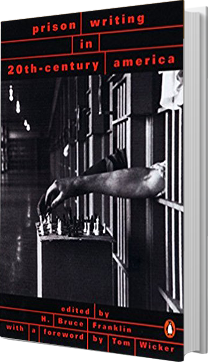
Includes work by: Jack London, Nelson Algren, Chester Himes,Jack Henry Abbott, Robert Lowell, Malcolm X, Mumia Abu-Jamal, and Piri Thomas.”
“Harrowing in their frank detail and desperate tone, the selections in this anthology pack an emotional wallop…Should be required reading for anyone concerned about the violence in our society and the high rate of recidivism.”—Publishers Weekly.
by Arnold Erickson
Prison has been a fertile setting for artists, musicians, and writers alike. Prisoners have produced hundreds of works that have encompassed a wide range of literature. Works by prisoners, such as Bunyan’s Pilgrim’s Progress, are counted among the great classics of literature. Books describing the prison experience, including the Autobiography of Malcolm X, inspired an audience far outside the prison walls. The importance of these works have been recognized in this country’s highest courts. See Simon & Schuster, Inc. v. New York State Crime Victim’s Compensation Board, 502 U.S. 105, 121-122 (1991)(citing works by prisoners). However, many of the finest prison writers remain unrecognized, and in some cases, unpublished.
H. Bruce Franklin‘s anthology, Prison Writing in 20th Century America, provides an important introduction to writers in prison. It includes both some of the most famous prison writing and that which remains relatively obscure. The writings focus on the prison experience itself, and provide a testimony to both the magnitude of the system and the struggle of human spirit.
Franklin places the prison system in a historical context. After slavery was abolished, prisons became the means to enforce servitude. The “Autobiography of an Imprisoned Peon,” published in 1904, vividly describes how a plantation was turned into an actual prison:
Every year many convicts were brought to the Senator’s camp from a certain county in Georgia, ‘way down in the turpentine district. The majority of these men were charged with adultery, which is an offense against the law of the great and sovereign State of Georgia!
The prisoners were housed in brutal stockades, whipped into submission, and forced to work on a large plantation.
This system was not limited to the South. Jack London describes time spent in the Erie County Penitentiary for vagrancy: a fifteen second trial and a thirty day sentence.
As for me, I was dazed. Here was I, under sentence, after a farce of a trial wherein I was denied not only my right of trial by jury, but my right to plead guilty or not guilty. Another thing my fathers had fought for flashed through my brain — habeas corpus. I’d show them. But when I asked for a lawyer, I was laughed at. Habeas corpus was all right, but of what good was it to me when I could communicate with no one outside the jail? But I’d show them. They couldn’t keep me in jail forever. Just wait till I got out, that was all. I’d make them sit up. I knew something about the law and my own rights, and I’d expose their maladministration of justice. Visions of damage suits and sensational newspaper headlines were dancing before my eyes when the jailers came in and began hustling us out into the main office.
London was put to work unloading barges on the Erie Canal and quickly became familiar with prison culture.
In the early part of this century, books by prisoners played an important role in inspiring reform. H.L. Mencken’s American Mercury magazine regularly printed works by notable prisoner authors, including works by Jim Tully and Ernest Booth that are found in this collection.
In 1934, Chester Himes published stories in Esquire while still a prisoner in Ohio State Penitentiary. His first story, “To What Red Hell,” described a fire that swept through the prison, written from the viewpoint of a white prisoner named “Blackie.”
Smoke rolled up from the burning cell block in black, fire-tinged waves. The wind caught it and pushed it down over the prison yard like a thick, gray shroud, so low you could reach up and touch it with your right hand. Flames, seen through the mist of smoke, were devils’ tongues stuck out at the black night. . . When Blackie turned left by the dining room he had an odd feeling that he could hear those men a hundred yards away crying “Oh God! Save me! Oh God! Save me!” over and over again. The words spun a sudden fear in his mind.
After his parole, Himes achieved critical acclaim in both the United States and Europe. Yet, it took until 1998 for his novel about his prison experience to be published, fourteen years after his death.
The success of many prisoner writers came with a price. Herman Specter, the senior librarian at San Quentin, wrote that there was a counterflow of reaction and prohibition. Prisoners were to be punished and were not to make money. Writing became banned and prisons were searched for manuscripts to be confiscated and destroyed — a system that lasted in California until death row prisoner Caryl Chessman smuggled out his manuscripts and helped break down the barriers that prevented prisoners from writing. It was not until 1968 that the state legislature formally abandoned the idea of “civil death” and afforded protection to manuscripts written by prisoners.
A different type of prison writing began to emerge. The Autobiography of Malcom X described the transformation of a common criminal into a Muslim who was destined to become one of the most significant leaders in modern American history. George Jackson’s Soledad Brother provided a witness that made the prison movement a part of the radical left:
This camp brings out the very best in brothers or destroys them entirely. But none are unaffected. None who leave here are normal. If I leave here alive, I’ll leave nothing behind. They’ll never count me among the broken men, but I can’t say that I am normal either. I’ve been hungry too long. I’ve gotten angry too often. I’ve been lied to and insulted too many times. They’ve pushed me over the line from which there can be no retreat. I know that they will not be satisfied until they’ve pushed me out of this existence altogether.
A new era in prison writing began to emerge as prisoners found a voice that at least some in the outside world were willing to hear. Malcom Braly’s On the Yard was labeled by Kurt Vonnegut as the “great American prison novel.” Etheridge Knight achieved wide recognition for his poetry, beginning with his first volume, Poems from Prison published in 1968:
The warden said to me the other day
why come the black boys don’t run off
like the white boys do?”
I lowered my jaw and scratched my head
and said (innocently, I think), “Well, suh,
I ain’t for sure, but I reckon it’s cause
we ain’t got nowhere to run to.”
The writers of the modern renaissance include Patricia McConnel, Jerome Washington, Dannie Martin, and Mumia Abu-Jamal. They speak in eloquent and rich voices. Yet, there is a constant struggle to be heard. The federal Bureau of Prisons successfully prevented Martin from writing under this own by-line in the San Francisco Chronicle. Right wing flurry forced the National Public Radio to withdraw its presentation of Abu-Jamal’s commentaries.
The selections in this book remind us both about how much and how little prison has changed. A Jack London may no longer be in danger of being forced to unload barges, yet the growth of private prisons, prison industrial authorities, and joint venture programs firmly retain the role of profit in the criminal justice system. The sheer growth of prisons and the call for harsher punishment has ended many of the programs that helped writers find their voice, yet writing will undoubtedly continue to emerge even as it did under similar conditions in the past.
Franklin’s anthology comes at a time when the criminal justice system needs to be re-examined. He reminds us that we are not that distant from when a black youth in Alabama was sentenced to life for stealing $1.50. How much different is it when other youth are sentenced to life imprisonment under our three strikes law after stealing a pack of cigarettes or selling $20 worth of cocaine? The prison experience seems destined to shape our society. For many it is the past, present, and future of what life will hold. For all, it requires critical choices about how our resources can best be used.
The anthology offers a view of over the prison wall. This view is needed all the more because media access has been sharply restricted in California prisons. It is the voice of the prisoner that alone may bring their experience to the public. The voice that Franklin presents is always provocative, often disturbing, and in some cases, inspiring. As Franklin concludes:
In the twilight of the twentieth century, the United States, birthplace of the modern prison two centuries earlier, has transformed the prison into a central institution of society, unprecedented in scale and influence. Out of this transformation has come another kind of writing, far more bleak and desperate than the prison literature of any earlier period. And yet even these works, rising like their forerunners from the depths of degradation, reveal the creativity and strength of humanity.
Prison Writing in 20th-Century America, edited by H. Bruce Franklin. Forward by Tom Wicker. Penguin Books, 1998.